
Local sightseeing information
Visit the setting for your journey through the four seasons... From recommended spots where you can fully enjoy nature to popular power spots, the area around the "Butai Pass Tourist Center" is full of healing places
Tourist route map
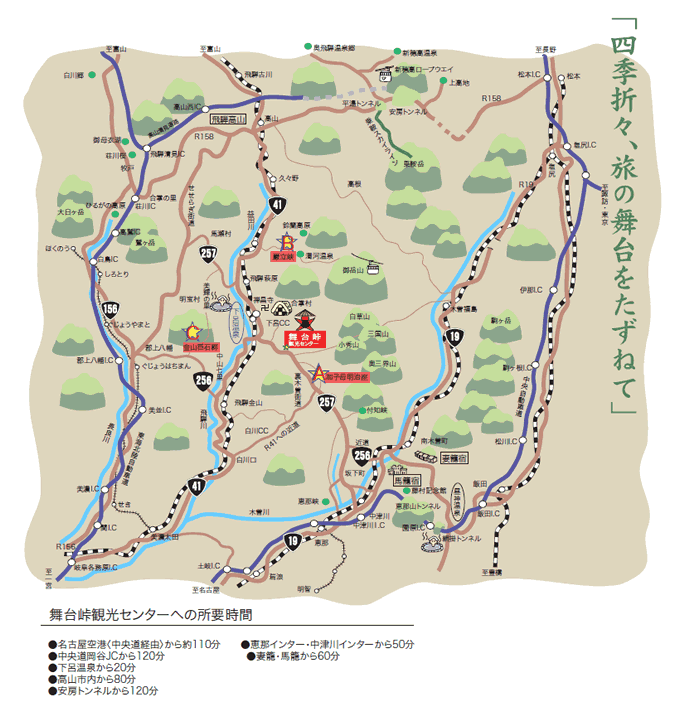
Kashimo Meijiza
https://meijiza.jp/
Established in 1894, the Kashimo Meijiza is a popular entertainment venue for the masses. As you travel along National Route 257, you'll see the striking old building of the Meijiza nestled on the hillside. This
rural theater, equipped with a revolving stage, trapdoor, and two hanamichi (runways), is designated as a prefectural tangible folk cultural property and has been cherished by the villagers as a "temple of entertainment." In its early days, in addition to local plays, it hosted traveling actors' performances, Joruri (narrative singing), magic shows, sideshows, and magic lantern shows, adapting to the trends of the times.
In the Taisho era, silent films with live narration and a band became popular, and in the Showa era, swordplay, revues, rōkyoku (narrative singing), and talkies became popular. After the war, in addition to Kabuki, it has hosted film screenings, manzai (comedy duo), and singing shows, allowing people to freely enjoy performances that suited the times.
Phone: 0573-79-3611
Business Hours: 9:00 AM - 5:00 PM
Closed: Mondays
Kashimo Village Board of Education: 0573-79-2111

Kashimo Giant Cedar, estimated to be over 1,000 years old, designated as a national natural monument
This large cedar tree was designated a national natural monument in 1924, and it is said that it was already a large tree several hundred years old in 1195, when Yoritomo ordered the Jizo Hall to be moved here.
It is one of the largest trees in the country, and its leaves remain lush and green as it continues to grow, protecting the Enmei Jizo statue from behind as if firmly embracing it, radiating a majestic brilliance that transcends time and space.
This Jizo statue is a life-sized statue of Jizo (Buddhist image) that is said to have been carved by the high priest Gyoki in 725, with each stroke of the chisel accompanied by three bows. It is revered as the Great Vow King Enmei Jizo Bodhisattva and is worshipped throughout the country as a Bodhisattva of longevity, safe childbirth, traffic safety, and family safety.
Parking available (accommodates large buses).
Restrooms available.
Visit the large cedar tree, pay your respects at the Jizo statue, and stroll around the Chichiko Pond – a round trip on foot of 200m
(barrier-free).

The Ultimate and Oldest Power Spot Guide
Ancient megalithic structures, exemplified by Stonehenge in England and the pyramids of Egypt, are now being discovered in the mountainous region of southern Hida, Gifu Prefecture. These megalithic structures are being revealed to have been a solar observatory from the Jomon period. The wisdom of ancient people,
far beyond the imagination of modern people, continues to quietly mark time in this place. The Kanayama megalithic group is located 300m downstream from the Iwaya Dam and consists of three locations: the "Iwaya Rock Shelter Site Megalithic Group," the "Megalithic Group with Incised Stones," and the "Eastern Mountain Megalithic Group." At the Iwaya
Rock Shelter Site Megalithic Group, there is a mechanism that allows for the observation of leap years using spotlights of light shining inside, and at the Megalithic Group with Incised Stones, traces indicating solar observations around the summer solstice are carved into the megaliths. The Iwaya Rock Shelter Site is a Jomon period historical site designated by Gifu Prefecture, and is also the place where the legend remains that Akugenta Yoshihira (Minamoto no Yoshihira), who once resided in Hida, defeated a monstrous baboon that tormented the villagers.
The wisdom of ancient people, far beyond the imagination of modern people, continues to quietly mark time in this place.
The Kanayama Megalithic Group is located 300m downstream from the Iwaya Dam and consists of three locations: the "Iwaya Rock Shelter Site Megalithic Group," the "Megalithic Group with Incised Stones," and the "Eastern Mountain Megalithic Group."
At the Iwaya Rock Shelter Site Megalithic Group, there is a mechanism that allows for the observation of leap years using spotlights that shine inside, and at the Megalithic Group with Incised Stones, traces indicating solar observations around the summer solstice are carved into the megaliths. The Iwaya Rock Shelter Site is a Jomon period historical site designated by Gifu Prefecture, and it is also the place where a legend remains that Akugenta Yoshihira (also known as Minamoto no Yoshihira), who once resided in Hida, defeated a monstrous baboon that was tormenting the villagers.

Please understand that the guided tour of the Kanayama Megalithic Site is completely different from a typical tourist guide. It is an academic field explanation conducted by a researcher of the megalithic site. The researcher will absolutely not provide a tourist-style guide. Also, currently there is only one female staff member who can provide field explanations.
Academic field explanation by a researcher of the megalithic site:
Approximately 1 hour per session, 3,000 yen.
Inquiries:
Kanayama Town Tourism Association TEL: 0576-32-2201
, Kanayama Megalithic Site Research Materials Room TEL: 0576-34-0073.
Tourist information including parking
: *There is only parking space for a few private cars near the megalithic site. Large buses are advised to wait at the Iwaya Dam parking lot after passengers have disembarked, approximately 500m away.
*Please note that mobile phones cannot be used in this area.
*Toilets are located at the Iwaya Dam parking lot.
*The "Eastern Mountain Megalithic Site" is located near the summit (approximately 560m above sea level) and requires a 50-60 minute climb.
Yumori Park and Ryujin Falls
Kawakami, as its name suggests, is a village in the upper reaches of the river.
The valley stream, which originates from Mount Okusankai, creates numerous waterfalls before flowing as the Kawakami River.
The hiking trail from Yumori Park to Mount Okusankai and its surroundings are an excellent course for waterfall hopping.
Crossing the Yumori Bridge on the campground's walking trail, the first thing that catches your eye is Ryujin Falls.
This waterfall, which flows down with such force that you can feel the spray on your body even from a considerable distance, is said to have once been a place where the dragon god was enshrined. The sound of the waterfall,
"Gooo, gooo," is so powerful that it drowns out all the surrounding sounds, and it certainly does sound like the roar of a dragon.
If you go further upstream to the source of Mount Okusankai, you will find many more waterfalls, including Doana Falls, Aze Falls, and Hitotsu Falls.
Each waterfall has a large volume of water and is very impressive.
Ryujin Falls has a drop of 12m and a width of 2m.
This crystal-clear water has been selected as one of Gifu Prefecture's 50 best waters.

Yumori Park
Location: 1060-11 Kawakami, Nakatsugawa City, Gifu Prefecture
Recommended seasons
: Cherry blossoms: April
Fresh greenery: May to July
Autumn leaves: Late October to late November